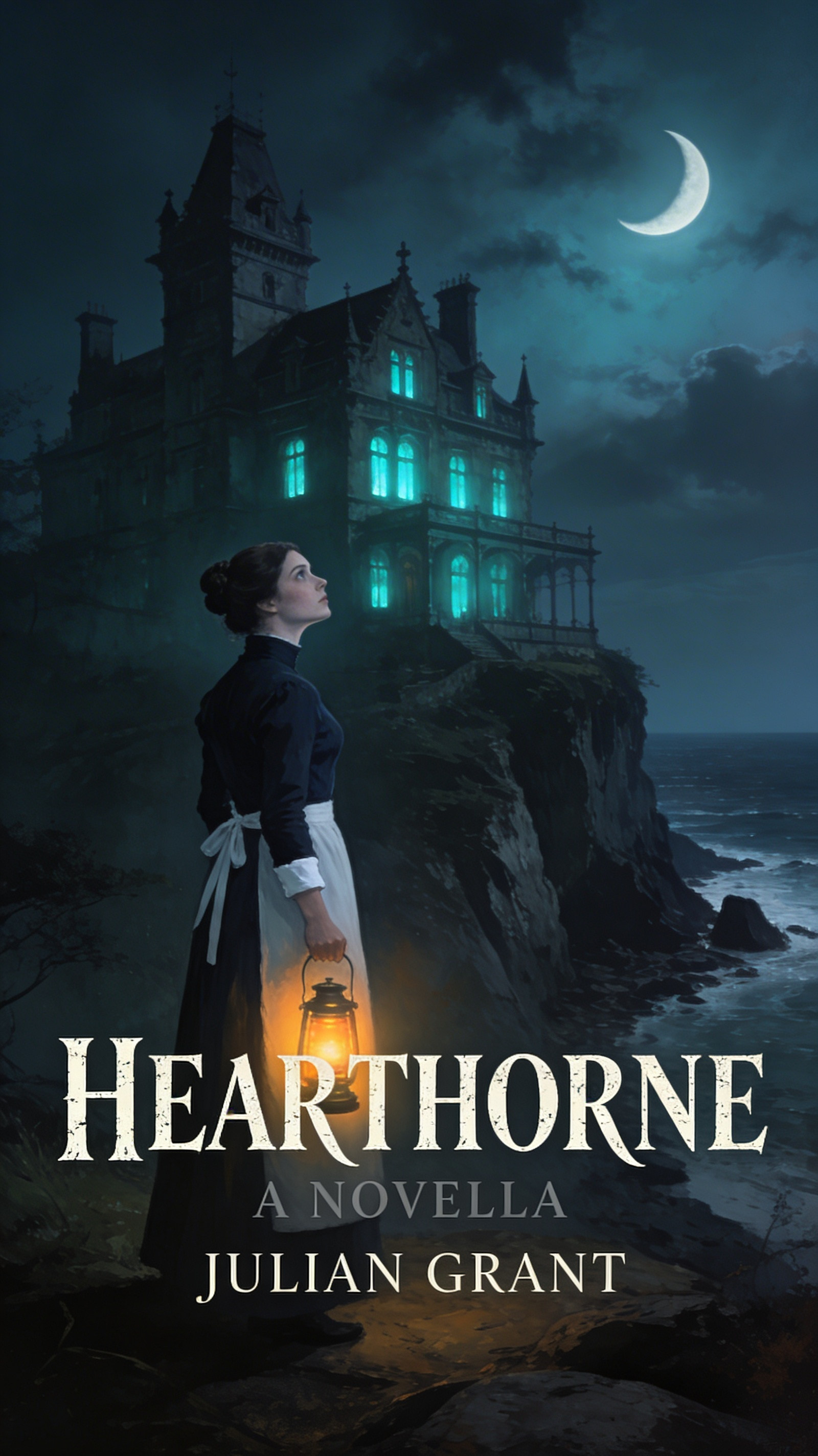

Aftermath and Transformation, 1872-1897
DOCUMENT 1: NEWSPAPER CLIPPING
The Cambridge Chronicle
December 17th, 1871
HEARTHORNE MANOR DESTROYED BY FIRE
Two Confirmed Dead; Professor Soames Rescued in State of Collapse
A devastating fire consumed Hearthorne Manor in its entirety on the night of November 16th. The blaze, discovered shortly after midnight by a passing traveler who observed flames visible from the main road, had already engulfed the entire structure by the time local volunteers arrived.
Three bodies have been recovered from the ruins. Lady Constance Soames aged approximately 50 years, proprietress of the estate, perished in the conflagration. Mr. Benjamin Wrexham, aged 63, groundskeeper at Hearthorne for the past forty years, was also found among the debris. The cause of Mr. Wrexham's death has been attributed to heart failure, though the coroner notes extensive burn damage prevented complete examination. Headsman Jarvis Winterbottom was also found amidst the wreckage, crushed by the falling roof.
Professor Edmund Soames, husband to Lady Soames and a former Fellow of Trinity College, Cambridge, was discovered wandering the grounds in a state of severe mental disturbance alongside the remaining kitchen staff. He was found in his nightclothes, incoherent and unresponsive to questions. Professor Soames has been conveyed to a private sanitarium in Cambridge where he remains under medical observation. The staff were unable to provide any additional information.
The cause of the fire remains undetermined. Magistrate's inquiry suggests the possibility of overturned lamps, though the rapid spread of the blaze has led some to speculate that combustible materials may have been present throughout the structure. Given the complete destruction of the manor, definitive cause may never be established.
Hearthorne Manor, built in 1841, was considered one of the finest examples of Georgian architecture in Lancashire. The estate encompassed 300 acres along the Irish Sea coast. No plans for rebuilding have been announced.
Local residents report that Professor Soames has no living family beyond his wife, and that the estate had no heirs. The disposition of the property remains unclear.
Funeral services for Lady Constance Soames and Mr. Benjamin Wrexham will be held at St. Michael's Church on December 28th.
DOCUMENT 2: JOURNAL ENTRY
From the Private Journal of Lizette Marchmont
December 8th, 1871
I have opened Mr. Wrexham's package.
I delayed for two weeks after hearing the news. Some part of me hoped I would never need to unseal it. That his warning—"Open only if Hearthorne falls"—would prove unnecessary. But Hearthorne did fall. Lady Soames is dead. Mr. Wrexham is dead. And I am left with a sealed parcel and instructions I can no longer ignore.
Inside I found three journals. Forty years of entries. Forty years of careful documentation. Forty years of horror witnessed and recorded in Benjamin Wrexham's methodical hand.
I have spent the past three days reading them. I wish I had not. I wish I could unknow what I now know. But he entrusted this knowledge to me, and I will honor that trust even as it fills me with dread.
The journals detail everything. The pattern of arrivals. The transformations. The thirty women who came to Hearthorne as employees or guests or companions and vanished into the water. He recorded each one. Names. Dates. Circumstances. He placed memorial stones for women whose families believed them drowned by accident.
He wrote of Lady Soames—not as I knew her, but as she truly was. The first bride. Transformed in 1842. Twenty-nine years as priestess to something he called "the entity." Something vast and old that dwelt beneath the lake. Something that marked certain women and called them into the water.
He wrote of Miss Beatrix Chalmers. The nurse who arrived in December 1870. How he watched her transformation begin. How she communicated with him from below the water. How together they planned rebellion.
He wrote about Miss Eleanor Ashford. The thirty-first bride who never arrived. How he forged a letter of dismissal on Lady Soames' stationery. How he spent forty years of savings—forty pounds—to ensure one woman lived who would otherwise have died.
The final entries describe the attack. The plan to burn Hearthorne. The seven transformed women who would surface to destroy Lady Soames and the manor. His acceptance of approaching death. His peace with the sacrifice.
"One life saved is enough," he wrote. "Eleanor Ashford lives. That matters."
I do not know what to do with this knowledge. Who would believe me if I spoke of it? Entities beneath the water? Women transformed into something inhuman. Patterns spanning centuries? I would be thought mad.
But Mr. Wrexham was not mad. His journals are too detailed, too methodical, too carefully cross-referenced with household records and local registry deaths. This happened. All of it happened.
I will keep his journals. I will keep his testimony. And I will never speak of this to anyone who might demand I prove what I cannot prove.
But I will remember. I will remember that Benjamin Wrexham spent forty years bearing witness to horror he could not prevent, and in the end found a way to save one life. I will remember that thirty women suffered and died in the deep places beneath Hearthorne. I will remember their names, as he recorded them.
And I will remember Miss Beatrix Chalmers.
May God grant rest to all of them. And may whatever guards those ruins now remember why it chose to stay.
DOCUMENT 3: NEWSPAPER CLIPPING
The Cambridge Daily News
April 17th, 1875
FORMER PROFESSOR DIES IN MYSTERIOUS CIRCUMSTANCES
Dr. Edmund Soames Found Drowned Despite No Water Source
Dr. Edmund Soames, 59, formerly Fellow of Trinity College, Cambridge, was found dead in his bed at Fenwick Private Sanitarium on the morning of April 15th. The circumstances of his death have baffled both medical staff and local authorities.
Dr. Soames, who had been a resident of Fenwick Sanitarium since December 1871 following the fire that destroyed his home and claimed his wife, was discovered by nursing staff during routine morning rounds. Despite being in a locked room on the second floor of the facility with no water source beyond a small washbasin, the deceased's lungs were found to contain a significant quantity of seawater.
"I have never encountered anything like it in thirty years of medical practice," stated Dr. William Graves, Chief Physician at Fenwick. "The patient showed no signs of distress when examined the previous evening. There is no conceivable way he could have drowned in his bed, and yet that appears to be precisely what occurred."
The coroner's examination confirmed that Dr. Soames' cause of death was drowning. The presence of seawater rather than fresh water has led to speculation, though no credible explanation has been offered. The room's single window was found locked from the inside, and no evidence of forced entry was discovered.
Dr. Soames had suffered from severe mental disturbance since the night of the fire that killed his wife, Lady Constance Soames. Staff reported that he frequently spoke of "water rising" and "voices calling from below," symptoms attributed to traumatic shock and subsequent delusions.
An inquest will be held, though authorities acknowledge that determining the exact mechanism of death may prove impossible. The matter has been referred to the Cambridge Constabulary for further investigation.
Dr. Soames leaves no surviving family. He will be interred in the Trinity College cemetery on April 20th.
DOCUMENT 4: FIELD NOTES
Site Investigation Notes - Dr. Margaret Ashworth, Folklore Studies
September 12th, 1897
Visited Hearthorne ruins today. Twenty-six years since the fire. Structure remains completely destroyed—only foundations and portions of the wine cellar intact. Local population avoids the site. Described as "unwholesome" and "cursed."
Interviewed three elderly residents who remember the fire:
Mr. James Pettigrew, age 78: Recalls Hearthorne as isolated even before the fire. "Strange place. Young women came and went. Seemed they drowned in the lake with alarming frequency. Old Ben Wrexham kept placing stones for them. Thirty stones, we counted after he died. Thirty women over twenty-nine years. That's not natural drowning. That's something else."
Mrs. Sarah Wickham, age 82: Remembers Lady Soames as "beautiful but ageless. She looked fifty for decades. Same face in 1870 as in 1850. People noticed but didn't speak of it. You didn't question the gentry."
Mr. Thomas Fletcher, age 69: "My father was there the night it burned. Said he saw shapes moving in the water before the fire started. Eight of them, he claimed. Rising from the lake and walking toward the house. Course, he'd been drinking, but he swore it to his dying day."
Investigated the ruins myself. Wine cellar is partially accessible despite collapse. Found evidence of passages leading deeper—limestone caves extending beneath the lake. Did not venture far (inadequate equipment, alone).
Notable discovery: Multiple recordings on wax cylinders hidden in a metal case within the collapsed cellar. All bear investigating.
Local legend speaks of "The Guardian”, something that protects the ruins but also keeps people away. Fishermen report strange movements in the water near Hearthorne on winter solstice nights. Shapes that surface briefly, then descend.
Some claim to have heard sounds from the passages—not quite human, not quite animal. A voice, they say, though the words are incomprehensible.
I attempted to explore the passages further but was overcome by a profound sense of wrongness. The air grew colder. The darkness seemed aware. I retreated.
Whatever dwells beneath Hearthorne, it has been there for at least twenty-six years since the fire. Possibly much longer. The question is not whether something guards the ruins, but what it guards against—and what it has become in the guarding.
Recommendation: Site should be sealed. Whatever is below should remain below.
Note: Cross reference with similar sites. Local fishermen mentioned "Innsmouth in America" when I asked about other places with similar legends. Worth investigating.
[Subsequent investigations of Hearthorne ruins decreased over the following decades as the site became increasingly avoided. By 1920, the ruins were considered too dangerous for casual exploration. Only dedicated researchers dared approach the site.]