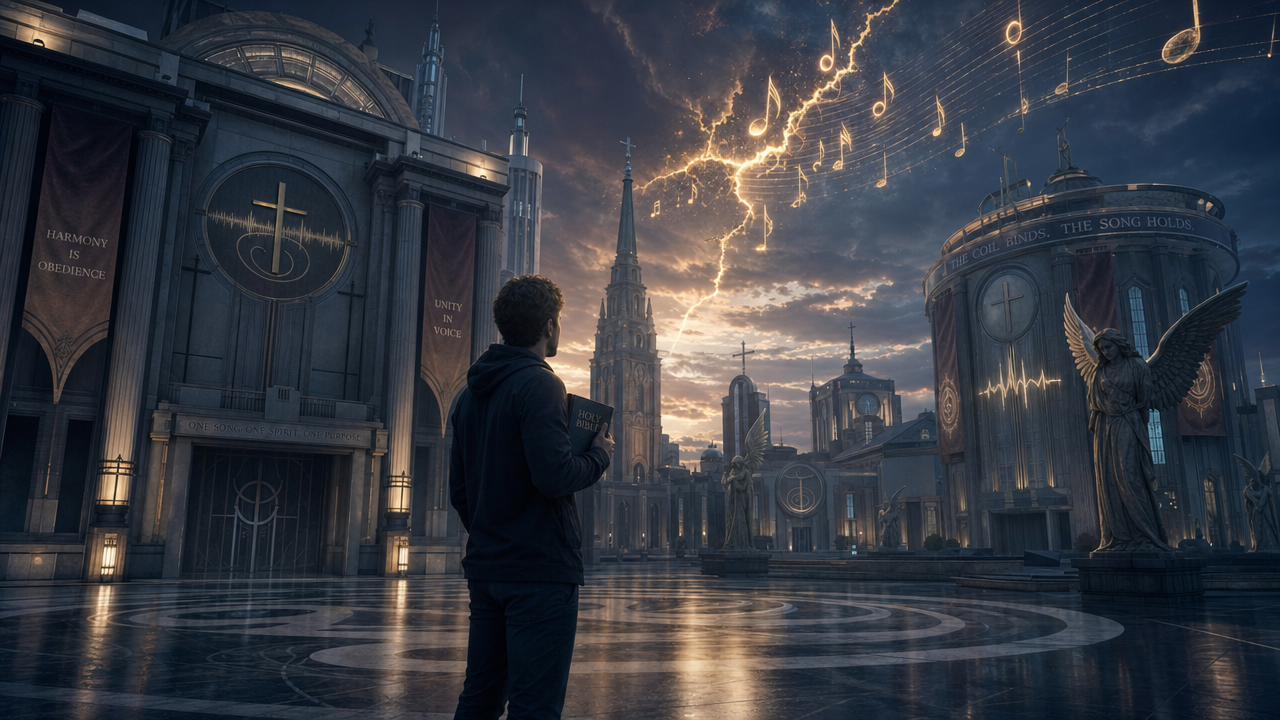
“Attention passengers. We will be approaching Stop 36: Oakhaven in precisely 5 minutes. If this is your stop, please prepare yourself to promptly disembark upon arrival.”
Kael smiled. He was always prepared for promptness. Even if the peaceful attunement music lulled him to sleep since the last stop. He also knew that he could never be too prepared, and grabbed the handles of his bags.
The train glided to a stop. “Stop 36: Oakhaven. Please make your way to the exit. The train departs again in precisely 60 seconds,” the melodic, yet disembodied voice of the Harmony Rail Network announced. With disciplined movements and speed, Kael was at the door as it opened.
Clean air hit his nostrils as he took in the scene. It was so different from the last time he’d been in this spot, and yet, as his eyes swept the platform, something about the precision felt too deliberate, as if the cleanliness had been scrubbed of all life. And it had taken a lot of hard work to get it this way. Every sleepless night, every difficult negotiation. All of his training as a Harmony Strategist had been put to the test, but more than that: his conviction. This town was particularly passionate and creative, and had a long history that was hard to combat. After four years of re-attunement therapy sessions, unburdening rites, and countless relegations, Kael was back for the first annual review of the Unburdening of Oakhaven. Pulling out his official Harmonious Coil tablet, he noted the pristine status of the platform before walking to the Guided Auto-Carriage rental counter.
“Kael Renwick, Harmony Strategist. I’m here to receive my Coil-assigned GAC,” he stated, drawing his shoulders back.
“Ah, yes. Here you are, Mr. Renwick,” the young lady at the counter said, her fingers pausing over the keys for just a beat longer than the task required before she continued typing. “GAC-413 will take you to your quarters, which have been prepared for your arrival, sir.”
"You have my thanks, Maureen," Kael responded, reading the name on her tag with the same precision he'd use for a civic report. The young woman's cheeks flushed, a tiny spark of unguarded response that felt almost inappropriate in this orderly space. He didn't linger on it. After tapping the key card on it, the screen on the door of the carriage requested his fingerprint for verification.
"Welcome, Kael Renwick," a melodic voice greeted him as the door slid open. He took a seat on the gray padded bench, soft but somehow impersonal, like sitting inside a polished, airtight vault. The transparent panels offered a 360-degree view of Oakhaven as the carriage glided forward, and Kael found himself studying the streets below with an appraiser's eye. Everything was perfectly visible. Nothing was hidden. This, he'd always thought, was the beauty of transparency. Now, watching the town slide past in eerie stillness, he wondered if perhaps visibility could also be a cage. The speakers spoke again. "You are being guided home."
The low glow ribbon along the ceiling shifted from idle blue to white as the carriage moved forward without a sound. Looking out through the panels at the streets of Oakhaven, he remembered how crowded and alive they were before he began his Strategic Unburdening Initiative. Now, they were orderly. Perfectly orderly. He tried to recall if he had ever seen a town so thoroughly at peace, and for a moment that felt suspiciously like a question, he wondered what the people did with themselves these days.
As the carriage rounded the central square, he caught a glimpse of the old market district. No haggling voices, no color, no overly crowded shops. Just the measured footsteps and downcast eyes moving in quiet compliance. Exactly as it should be. He looked away.
"Just as it should be," Kael said to himself. Looking at the data on his Coil tablet, he saw the civic metrics of Oakhaven were at the standard level for a town one year after its Unburdening. There hadn't been any crimes reported in months, and disputes between citizens were minimal and still within Coil regulation.
He should have opened the report template then. He knew the order of operations by heart–metrics, summary, recommendations–the same sequence drilled into him until it felt almost like liturgy. The tablet’s light hummed against his vision, a steady white glow that usually soothed him the way attunement music did. Today it made his eyes ache.
Instead, he scrolled back through the data a second time, then a third. Zero disputes escalated. Zero creative variance flagged. Zero anomalies of any kind. No emotional outbreaks. No dissenters. It was, by every measurable standard, a perfect result.
He recited the success metrics in his head like a prayer, trying to drown out the heavy silence of the street below. Zero disputes. Zero variance. A perfect result. He had earned the right to feel proud of that. He told himself so twice more before he believed it even a little.
He set the tablet face-down on the Coil-issued desk, and pushed back from it. His fingers hovered over the edge for a moment, as if the device might call him back. It didn’t. The silence in the room swallowed even that thought.
He thought back to the Unburdening of Los Angeles. That was a massive project that took much longer than it took for Oakhaven, and a much bigger team of Conductors, Strategists and Unburdening Custodians to complete. But now, the city was spotless; cleaner than it had been since its founding. There was no crime, nor any disputes reported during his audit there last month. The people were at peace for the first time in centuries. He remembered standing along what had been Hollywood Boulevard, taking in the clean air and watching the sunset without smog dimming it. Everything was in harmony.
Numbers couldn’t tell him why the streets looked the way they did from the carriage window.
Numbers are enough, he reminded himself, the way instructors had when he was a trainee and questioned a projection. Numbers don’t lie. But the memory of the empty platform and the too-clean streets pressed in, stubborn as a splinter.
He poured a glass of water he didn’t particularly want and stood at the window, looking out at the town below. The water tasted like the room looked: clear, filtered, stripped of anything that didn’t serve function. He swallowed anyway. That was what the Harmonious did. He should have felt proud. Instead, he stood, staring out at the empty streets below, listening to the quiet, and found he couldn’t bring himself to write a single word of the report.
Kael decided he needed to take a walk to see the town for himself rather than rely on what had been filed through official channels. It was not the recommended procedure. Reports were to be built on filed data and verified logs. Still, his hand found the door handle before he’d quite finished reminding himself of that.
Walking from his apartment to the town square, he saw a couple people walking along the pristine Pedestrian Flow Corridors. Their glazed eyes didn’t meet his, and he told himself he was fine with that. Eye contact wasn’t a metric anyway. Civic contentment equals regulated compliance, he recited inwardly, borrowing a phrase from the Lexicon. Visible emotion introduces variance.
The Harmony speakers were playing the attunement music at the correct frequency, the placid, measured tones the Coil prescribed. This was exactly what he was looking for. The tones brushed against his temples like a familiar hand, but where they usually smoothed his thoughts, they left a faint, restless edge instead. As if some part of him had forgotten how to be quiet on command.
At the center of the town square, he saw a familiar face. The town's master woodcarver, James Sequoia. A man Kael remembered well from before the Unburdening. Fiery and confident, the kind of person who had made Kael wonder for a time whether Relegation to the Fray might be necessary, out past the Coil’s borders, where the unattuned were left to fend for themselves on unregulated ground. But the man had submitted to Attunement in the end.
He remembered the way the woodcarver had once argued. Not just with words, but with his whole body, as if his hands were still shaping unseen timber while he spoke. Variance expressed physically, the training manuals had called it.
Now the old man sat slightly hunched, his hands idle in his lap, eyes glazed and unfocused where a flicker of flame used to live. Is there something wrong with him? Kael lingered on the question longer than he expected to. No, he’s been Unburdened. There’s nothing that could be wrong. The thought landed with the clean, metallic certainty he’d always trusted. And yet, watching those idle hands, the word wrong refused to dissolve. It sat heavy, unfiled, in the back of his mind as he turned away. He almost reached toward him, as if to prove to himself that the old man was still there, and not just a number that had stopped moving. That would be deviating from protocol more than he already was. He moved on, more quickly than felt comfortable.
He remembered a children’s park not far away, and decided to test his hypothesis there. A sign at the entrance posted the Coil guidelines: “No yelling. No running. No climbing. No swinging. No competitive games.” The list read like music to a Strategist’s ear. Every potential spark dampened before it could catch. It matched the projections he’d made a year ago almost exactly. Rubber matting covered the ground. Muted, calming colors marked the equipment.
It was quiet, which Kael noted was the opposite of every children’s park he’d ever known. The few children present took turns on the slide with robotic patience. Near the fence, a brother and sister worked silently together on a puzzle laid out in the astroturf grass. He watched them finish and move wordlessly to the next one. No celebration. No argument over who had done more. In his training simulations, children had always been the unpredictable variable. Laughing too loudly, racing when they were supposed to walk, turning even regulated games into contests. The models had treated that chaos as a problem to be solved. Watching these children, he realized the problem was gone. So was the chaos.
He stood at the fence longer than he’d planned, and found he wasn’t sure what he was waiting for. A shout. A spill. A scraped knee and a wail. Anything that would prove the town had something left that couldn’t be graphed. Nothing came.
He had set out to relieve Oakhaven of its burdens. Walking back through the silent streets, he found himself wondering if perhaps he had relieved it of everything else as well.
He stopped once on the way back and looked at the empty bench outside what had been the baker's shop. He didn't know why he stopped. For a moment, he almost smelled something that wasn’t there: warm bread, sugar, the faint tang of citrus. The memory dissolved before he could decide whether it was real or something he’d constructed from a ledger line labeled Baking Supplies.
He kept walking. He should have gone back upstairs, opened the template, and done what the Coil expected of him. That was the path laid out, the one he’d walked in every other town. His feet refused it.
The report could wait. If there was something to understand here, it would be in the records, the town's history before the Initiative. Numbers told you what a town was now. Records told you what it used to be. He turned toward the archive.
By the time the Town Center came into view, Kael noticed he was walking faster than was regulation pace. He deliberately slowed his steps, and glanced around for any curious eyes. There were none. People in Oakhaven weren’t curious anymore. He entered the crisp building and headed straight for the stairs. The air grew colder as he descended, smelling of dust and old paper. He made his way to the back corner with the table, noting the dust and the papers strewn about. The archive had been left deliberately uninviting, the Coil preferred citizens not get curious and wander into the past.
Several ledgers were stacked on the table and shelved nearby. He pulled one. The year on the spine read 2025. He opened it. Columns of figures marched down the page, numbers he could read, each followed by text he couldn't. But the amounts were staggering, and the pattern was clear enough without the labels: recurring expenditures, large and consistent, spread across what appeared to be specific points in the year. Whatever these entries were, Oakhaven had spent extravagantly on them. Resources far beyond any measurable civic return.
It was extravagance reduced to ink and numbers, and even so, something in the margins felt loose, as if the ledger itself knew more than it was saying.
As he flipped through the pages, a folded piece of paper fell to the floor, old, slightly torn. He picked it up and unfolded it.
“Play yard stones too clean
Cracked hands too still
Salt water locked inside
Yet, the wind whispers in the leaves
It speaks against their will
Holds fast against their might
Let the flowers fade, let the grass return to dust
What He has spoken cannot be undone
Ignore it, if you must
But you will reap what you become”
He read it once, quickly, the way he read reports. Then again, slower, as if the words might rearrange themselves into something he could file and categorize. They didn't.
He searched for a familiar label, civic warning, dissent, emotional variance, but none of them fit. The lines refused to flatten into something measurable, into a category, like water slipping off the edges of a report template.
He felt the old, crinkled paper in his hand. Dry like something that had forgotten how to bend..
A tightness filled his chest. A quick, sharp pain hit his spine. His breath quickened, and a slight dizziness pressed in at the edges of his vision. What is happening to me?
He set the paper down carefully, as if it might do something. Then he opened the ledger back to the numbers and stared at them until his breathing steadied. Numbers were safe. Whatever he was experiencing didn't feel safe.
Sitting down, he thumbed back through the 2025 ledger. Every line carried a number that would have flagged immediately in any Coil audit. Line after line of figures that dwarfed anything a standard civic budget would justify. He couldn't read what the entries were for, but the numbers themselves told a story: large, consistent, and spread with a rhythm that suggested not emergency spending, but tradition. Month after month, year after year, something in this town had cost a great deal and kept costing it. He checked the year again. Perhaps it had been a special occasion.
He reached for Festival Funding 2002.
Same thing. Festival Funding 2013. Same thing. Festival Funding 1998. Same thing. Ledger after ledger, the pattern held, consistent spending across twenty-seven years, even accounting for inflation. He began to notice that one recurring label, unreadable to him, its letters that looked like ones he knew, but twisted into shapes different from the Harmonic Script, appeared every spring without fail, always commanding the highest expenditure of any entry. Whatever it was, Oakhaven had spent more on it than anything else, year after year.
He moved past stacks of old weather reports and birth certificates, his heart thumping against his ribs as if he were hunting for a ghost. An old photograph on the wall caught his eye, a farmer's market in the town square, taken decades before his time. A lumbermill's shop with its family of woodcarvers stood nestled next to a music store, a guitar and saxophone visible in the windows. The woodcarver family: two adults and five children. The youngest boy had a familiar flare in his eyes.
Kael leaned closer.
The old man from the park. Before.
He stood there longer than he meant to, his hand hovering near his mouth without quite realizing it had moved. Shaking his head, he turned back to the ledgers.
He looked around for more photos and found an album whose spine carried the same year as the ledger in his hand: 2025. Oakhaven had a dedicated photographer, it would seem. The book had pictures from every month of the year, each section marked by a number he recognized, 1 through 12, followed by text he couldn't read. Pictures of what appeared to be everyone in town. One section, filed under what his ledgers had marked as the fourth month, had images of the town square filled with eggs hidden as children seemed to look for them. Images of the old church full of people. Some of the images showed the people with their heads bowed. What are they doing?
He had graphs that showed spikes in attendance around this “Easter,” neat curves of movement and noise he’d been proud to smooth out. None of them had prepared him for the sight of faces bent in unmeasured attention toward something he couldn’t name.
He’d never known what a church was used for, just that he had to convert it into a Coil approved building during the Unburdening. Oakhaven’s chapel was converted into a Harmonization Assembly hall, the Hall of Accord. There was a cross with a man hanging from it wearing what looked like a crown made of thorns.
Kael cocked his head to the side. He couldn’t classify what he was looking at, and that bothered him more than he expected. He turned the page.
The seventh month showed fireworks over the square, faces tilted upward, mouths open. Civic celebration, he thought, reaching for the nearest approved term. But the word felt thing next to the image, like a label stuck on the wrong jar. The tenth: children in costumes, laughing at something he couldn't see. Recreational compliance? That fit even worse. The eleventh: long tables, crowded, people passing food with both hands. He tried resource distribution and nearly laughed at how wrong it sounded in his own head. And then the twelfth...
That man on the cross again. He stared at an image of just the church’s cross man. He didn't know how long he stared. Something pressed lightly against the inside of his chest, not the sharp pain from before. Something quieter. He closed the album. He moved on to the album for Festivals 1998 and saw the same things. He kept grabbing photo albums.
Every time he found a picture of the cross man, something stirred in him. And he was in every album, and not only during whatever was celebrated in the fourth month and the twelfth. It seemed like the people of Oakhaven really liked going to church and the cross man was in the background of a lot of the pictures taken. And there were so many smiles photographed in these albums that it was hard for Kael to ignore.
"What if these numbers…" he said slowly, his hand passing over one of the ledgers as if he could feel what they meant. "…translate into something like community joy?" The sound of his own voice startled him. The quiet had been that complete.
Joy. He knew the word. He could have defined it from the Coil's Lexicon of Regulated States. But looking at the youngest boy's face in that photograph, he wasn't sure the definition he knew and the thing he was looking at were the same word at all.
He searched for the oldest photo album he could find, and found a smaller one, its spine worn and the year barely legible: 1965.The photographs inside were black and white, the faces somehow both more distant and more alive for it. As he slowly flipped through the images, he fell into a sort of trance that he was only pulled out of by a buzz buzz from his Coil phone. He glanced at it and found an official message from his superior, Conductor Valerius that read, Requesting review report on Oakhaven. Expected promptly.
He looked at the album still open in his hands. Then at the phone. Then back at the album. The word promptly had always sounded clean to him, a virtue pressed into a single syllable. Now, with the cross man staring up at him from the black and white paper, it rang more like a warning.